
AI Adoption, Built For Production.
Most organizations are already somewhere on the AI maturity continuum. ChatGPT is in the workflow, Copilot is in the IDE, and a few teams have tried to build something more ambitious. The question is no longer whether to adopt AI. It is how to mature past pilots into production systems that move business metrics, with guardrails the compliance team can defend and teams that can run the systems after we are gone.
Why Most AI Adoption Stalls After the First Pilot
Enterprise AI adoption fails in predictable ways. A team finds a promising use case, builds a pilot, demos it to leadership, and then watches the initiative stall when it meets real infrastructure constraints, real data quality gaps, real governance requirements, and the real workflows of the people who were supposed to use it. The pilot did not fail because the model was wrong. It failed because the organization was not ready to operate it.
AI adoption is the process of moving an organization along a maturity continuum, from isolated tool usage to production AI systems that deliver measurable business outcomes. It covers strategy, technology, data readiness, governance, and the people who will run the systems after deployment. Done well, it produces quantifiable ROI and stronger internal teams. Done poorly, it produces shadow AI, stalled pilots, and a backlog of governance debt.
Last updated: May 2026
Stride's AI Adoption Formula for Success
Business outcomes over tooling selection. The right model, vendor, or platform is the one that moves a specific business metric for a specific team. We start from the outcome, not the tool.
Team-building and upskilling. A roadmap that your team cannot execute is a roadmap that does not get executed. We build internal capability as the engagement proceeds, so the work continues after we leave.
Real ROI as the deliverable. Every initiative we recommend is tied to a quantifiable outcome: analyst hours recovered, cycle time compressed, support volume absorbed, error rates reduced. If we cannot quantify it, we do not recommend it.
Stride's engineers have shipped AI systems in healthcare, financial services, and enterprise software. The advice we give is grounded in what we have built in production, not in framework slides.
See Stride's case studies95%
of enterprise GenAI pilots fail to scale to production
Stride's AI Adoption Approach vs. The Common Alternatives
| Stride's AI Adoption | Strategy-Only Consultancy | Tools Vendor / Reseller | |
|---|---|---|---|
| Primary deliverable | Production AI with measurable ROI | Strategy deck | License + implementation |
| Team capability after engagement | Stronger; internal team owns the systems | Unchanged | Dependent on vendor |
| Scope shape | Matched to your maturity stage | Fixed framework | Fixed product |
| Governance | Built in from day one | Recommended, not implemented | Buyer's responsibility |
| Engineering depth | Engineers who have shipped production AI | Strategists, not builders | Sales + implementation |
| Tied to a specific tool | No, recommended based on fit | Sometimes | Yes, by design |

What AI Adoption Work Looks Like at Stride
Every AI adoption engagement is shaped around what the client actually needs, sequenced by where the organization sits on the maturity continuum. Across that work, the same activities recur. These are the components a Stride AI adoption engagement is built from, in any combination the work requires.
AI Maturity Assessment & Use Case Identification
We start by understanding where the organization actually is on the AI maturity continuum and where the highest-leverage opportunities sit. Use cases are surfaced from inside the business, not from a vendor catalog, and ranked against the metrics leadership is already accountable to.
ROI Modeling & Phased Roadmap Design
Every recommended use case is tied to a quantifiable outcome: analyst hours recovered, cycle time compressed, support volume absorbed, error rates reduced. The output is a phased roadmap with dependencies, prerequisites, and a sequence built around what the organization is ready to execute, not a wish list.
Data Readiness & Guardrails
Most AI initiatives stall on data quality and access boundaries, not model selection. We assess the data architecture, identify what needs to be true before each use case can ship, and design the guardrails that keep sensitive information either inside the workflow or out of it, depending on what the regulatory environment requires.
Process Redesign & Governance Architecture
AI changes how work moves through an organization. We redesign the workflows the AI will touch and build governance in as an architectural input: human-in-the-loop process design, audit logging, drift detection, role-based access, and the controls a compliance team can defend on day one.
Engineer Upskilling & Tool Selection
A roadmap your team cannot execute is a roadmap that does not get executed. Stride engineering leadership runs hands-on sessions in the client codebase, recommends tools matched to role and SDLC stage, and adapts agile and review practices for AI-assisted work so velocity gains do not become technical debt.
Agent Design & Human-in-the-Loop Deployment
For workflows where intelligent agents create real leverage, we design agents that fit the regulatory and operational context, with explicit escalation paths and human oversight built into the architecture. Non-deterministic agentic systems are deployed to operate safely inside the deterministic systems the business already runs on.
Where Stride’s AI Adoption Clients See the Fastest ROI
Financial Services
Stride has built AI agents that query finance databases using natural language and generate complex financial models in minutes instead of hours. For CFOs and FP&A teams, this is one of the clearest demonstrations of AI adoption ROI: measurable in analyst time saved per quarter. The governance framework satisfies model risk management requirements, including SR 11-7 alignment.
Healthcare
Stride's AI adoption framework addresses HIPAA compliance, clinical workflow integration, bias prevention, and human-in-the-loop requirements before a single model is selected. Production experience in healthcare means the governance architecture is built for audit from day one, not retrofitted after an incident. AI that clinical teams trust and compliance teams can defend.
Software Engineering
Stride uses AI tooling to compress delivery timelines while maintaining quality: automated code review, AI-assisted specification writing, and test automation. This approach typically compresses timelines by 30-40% on greenfield builds while maintaining the test coverage and review standards that prevent AI-generated technical debt. Stride's adoption framework governs AI-assisted code to prevent over-reliance without human review.
Real Results From Production AI Adoption
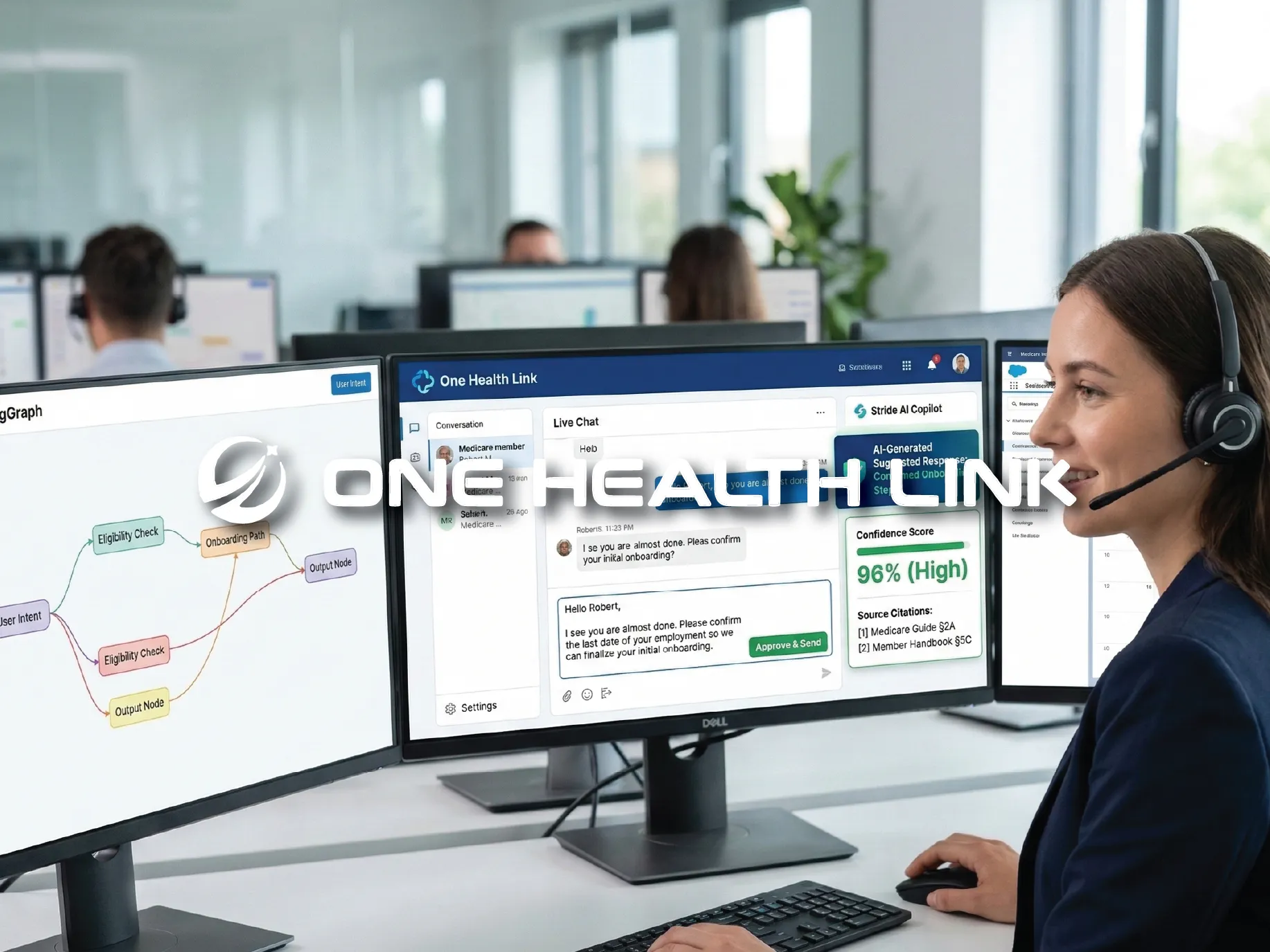
AI Adoption Cuts Live Chat Response Times From Minutes to Seconds
One Health Link partnered with Stride to build an AI-powered agent portal for their live chat call center. Intelligent response suggestions auto-populate in agent workflows while clinical oversight stays human-in-the-loop and HIPAA compliance is preserved end to end.

AI Adoption Compresses Financial Analysis From Hours to Minutes
A financial technology firm adopted AI-powered natural language querying to unlock institutional knowledge trapped in proprietary databases. Analysts now generate complex multi-period financial models in minutes, with no code required and full auditability preserved.

AI Adoption Uncovers Decades of Technical Debt and a Path Forward in Weeks
A Latin American automotive group adopted Stride's AI tooling to tackle a decades-old dealer management system. AI agents cut module analysis from days to hours, giving leadership a concrete adoption roadmap and a path to modernization without a costly full rewrite.
Frequently Asked Questions About AI Adoption
What is AI adoption and why do enterprises need a consulting partner?
AI adoption is the process of moving an organization along a maturity continuum, from isolated tool usage to production AI systems that deliver measurable business outcomes. Enterprises engage a consulting partner because the work spans strategy, technology, data, governance, and people, and those dimensions rarely align without coordination from someone who has done it in production. The right partner accelerates the work, prevents the architectural mistakes that create technical debt, and builds governance in from the start rather than retrofitting it after problems emerge.
What does Stride's AI adoption practice actually deliver?
A measurable business outcome, a stronger internal team, and a governance posture your compliance team can defend. The work inside an engagement covers AI maturity assessment and use case identification, ROI modeling and phased roadmap design, data readiness and guardrails, process redesign and governance architecture, engineer upskilling and tool selection, and agent design with human-in-the-loop deployment. Each engagement is scoped to where the organization sits on the AI maturity continuum.
Why does AI adoption fail?
AI adoption fails in five predictable ways. First, poor sequencing: launching a pilot before the data infrastructure, governance posture, and organizational readiness have been assessed. Second, governance as an afterthought: building AI systems and retrofitting compliance controls after deployment. Third, data quality gaps that surface mid-pilot. Fourth, shadow AI proliferation, where employees adopt consumer AI tools faster than IT can approve them. Fifth, no organizational readiness: the people who will use the AI are not prepared for how their workflows will change. Stride's adoption work surfaces all five before they derail production deployment.
What is the difference between an AI pilot and AI adoption?
A pilot is an isolated experiment designed to test whether a specific AI application works under controlled conditions. Adoption is the process of integrating AI into ongoing operations in ways that are reliable, scalable, and governed. Most organizations have run successful pilots. Far fewer have adopted AI at scale. The gap involves data infrastructure, integration with production systems, change management for users, governance, and the internal capability to maintain and evolve the systems over time.
How does Stride approach AI governance?
Governance is an architectural input, not a compliance checklist completed after deployment. Stride's work covers six dimensions: human-in-the-loop process design, bias prevention and monitoring, CI/CD standards for AI model updates, model observability and drift detection, audit logging and explainability, and role-based access controls appropriate to your regulatory environment. Each use case in the roadmap includes a governance specification for that specific application.
How does Stride prioritize AI use cases?
Stride ranks AI use cases against three variables developed from production engagements across fintech, healthcare, and enterprise software. The first is estimated business value, quantified against your specific KPIs and cost structure. The second is implementation complexity, assessed against your actual data architecture, integration landscape, and team capability. The third is organizational readiness for that specific use case, measured by user fluency, process maturity, and governance posture. The output is a ranked portfolio where high-value, low-complexity, high-readiness initiatives move to pilot first. More complex initiatives enter the roadmap with explicit prerequisites.
What industries does Stride have AI adoption experience in?
Healthcare, financial services, fintech, education, enterprise SaaS, e-commerce, and media. In healthcare, Stride has built AI agents that automate patient interactions while maintaining HIPAA compliance and clinical governance. In financial services, Stride has built AI systems for financial modeling and analysis automation. In enterprise technology, Stride has guided LLM adoption for knowledge management, compliance documentation, and internal tooling. Each sector involves distinct governance requirements and data sensitivity considerations.
How is Stride different from other AI adoption consulting firms?
Three things. First, Stride is a builder, not just a strategist. The engineers who design your AI adoption work have deployed production AI systems in regulated industries. The advice reflects what works in production, not what looks good in a framework slide. Second, Stride scopes to your maturity stage, not to a fixed template. Some clients need strategy and roadmap work. Some need engineer upskilling. Some need agent design and deployment. Most need a combination, sequenced correctly. Third, Stride builds toward your independence. Every engagement transfers knowledge to your internal team and leaves you equipped to run, govern, and evolve your AI systems without Stride in the room.
AI Adoption Insights from Stride
Strategy First: Why the Crawl Phase Determines Everything
Getting AI adoption right starts before the first tool is deployed. Francisco Martin on why the crawl phase determines everything that comes after it.
Read More →How AI Is Transforming the Software Services Industry
The structural shift reshaping how software services firms compete as AI moves from add-on to core delivery. What changes for the firms that build, and the buyers who choose them.
Read More →How We Built a Clinical AI Agent
A production walkthrough of the AI agent Stride built for a healthcare client, supporting patients in a sensitive clinical use case using LangGraph, Claude Sonnet, human-in-the-loop safeguards, and a custom evaluation framework.
Read More →Let's Define What AI Should Do For Your Business.
The most important AI decisions your organization will make this year are not about which model to license. They are about which problems to solve first, what good looks like when AI is in production, and how to build the internal capability to keep evolving the systems after launch. Stride's AI adoption practice exists to help engineering and technology leaders answer those questions with clarity. Whether you are mapping your first roadmap, preparing your engineering team, or designing agents for a regulated workflow, the conversation starts the same way: by understanding where your organization actually is on the AI maturity continuum and what would matter most if it moved forward.